What Is Implied Probability — and Why Every Bettor Should Calculate It
Implied probability turns a price into a percentage. It is the single most useful number for judging whether a bet makes sense.

Table of contents
Quick answer
Implied probability is the chance of an outcome suggested by its odds: 1 ÷ decimal odds. Odds of 2.00 imply 50%, 4.00 implies 25%. Because bookmakers add a margin, the implied probabilities of every outcome in a market add up to more than 100%.
The one formula to remember
- Definition Implied probability
- 1 ÷ decimal odds × 100. For fractional odds a/b: b ÷ (a + b) × 100.
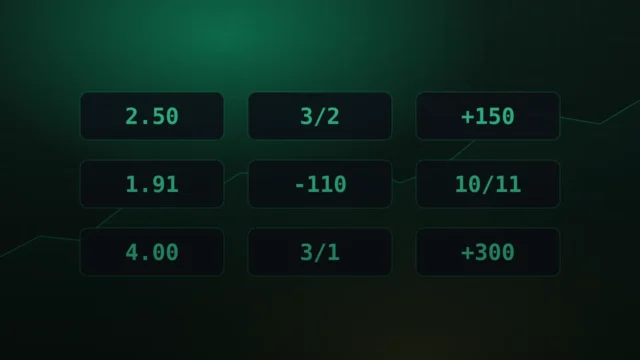
A price of 2.50 implies 40%. A price of 1.25 implies 80%. When you think about bets as percentages, it becomes much easier to ask the right question: *is this outcome really that likely?*
Why the market total is above 100%
In a fair coin-toss market, both sides would be priced at 2.00 (50% + 50% = 100%). A bookmaker might offer 1.91 on both: 52.4% + 52.4% ≈ 104.7%. The extra 4.7% is the overround, the bookmaker’s built-in edge.
Comparing implied probability with your own view
Value only exists when your estimate of the chance is higher than the implied probability. If a team is priced at 3.00 (33.3%) and you believe they win 38% of the time, the expected value of a 10 bet is 0.38 × 20 − 0.62 × 10 = +1.40 — in theory, averaged over many such bets.
Try it
Implied Probability Calculator
Free · no sign-up · calculates as you type
Frequently asked questions
How do I calculate implied probability from fractional odds?
For a/b odds, it is b ÷ (a + b). At 3/1 that is 1 ÷ 4 = 25%.
Is implied probability the real chance?
No. It is the market's view plus the bookmaker's margin.
Sources & references
- UK Gambling Commission www.gamblingcommission.gov.uk
- BeGambleAware — safer gambling advice www.begambleaware.org
- National Council on Problem Gambling www.ncpgambling.org
We check every figure against the source listed. Spotted an error? Request a correction.
Related topics