Value Betting Explained: The Maths, the Myths and the Limits
Value betting is the idea behind every serious betting approach. It is simple to state and very hard to do well.

Quick answer
A value bet is one where your estimate of the true probability is higher than the probability implied by the odds. Over many bets, consistently finding value would produce a positive expected return — but only if your estimates are genuinely more accurate than the market.
The definition
- Definition Value bet
- A bet where your estimated probability of winning is greater than the implied probability of the odds.
Expected value, step by step
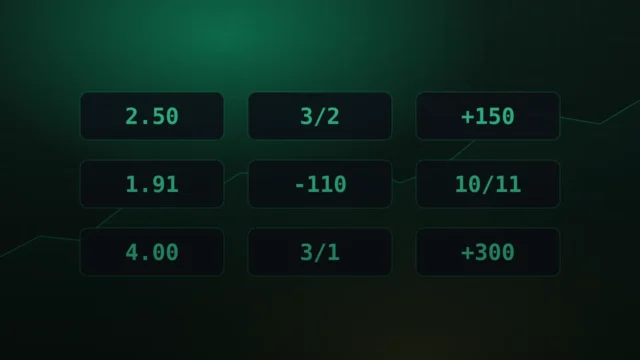
Suppose a price of 2.50 (40% implied) and your estimate of 45%. For a 10 stake:
- 45% of the time you win 15 → +6.75 on average
- 55% of the time you lose 10 → −5.50 on average
- Expected value: +1.25 per bet, *over the long run*.
The myths
- “Value bets usually win.” No — a value bet at 2.50 still loses more often than it wins.
- “A big price is value.” Long odds are not value unless the true chance is higher than implied.
- “A few winning weeks prove it.” Short samples are mostly noise.
The limits
Bookmakers adjust prices quickly and may limit accounts that consistently find value. Above all, value depends entirely on the quality of your estimate.
Frequently asked questions
Does value betting guarantee profit?
No. It is a framework for judging prices. Even genuine value bets lose often, and most people overestimate their edge.
How do I know if I am finding value?
Over hundreds of bets, compare the odds you took with the closing odds. Consistently beating the closing price is evidence, not proof.
Sources & references
- BeGambleAware — safer gambling advice www.begambleaware.org
- National Council on Problem Gambling www.ncpgambling.org
We check every figure against the source listed. Spotted an error? Request a correction.
Related topics