How Betting Odds Work: Decimal, Fractional and American Odds Explained
Odds tell you two things at once: how much a bet pays and how likely the bookmaker thinks it is. Here is how to read every format — and convert between them.
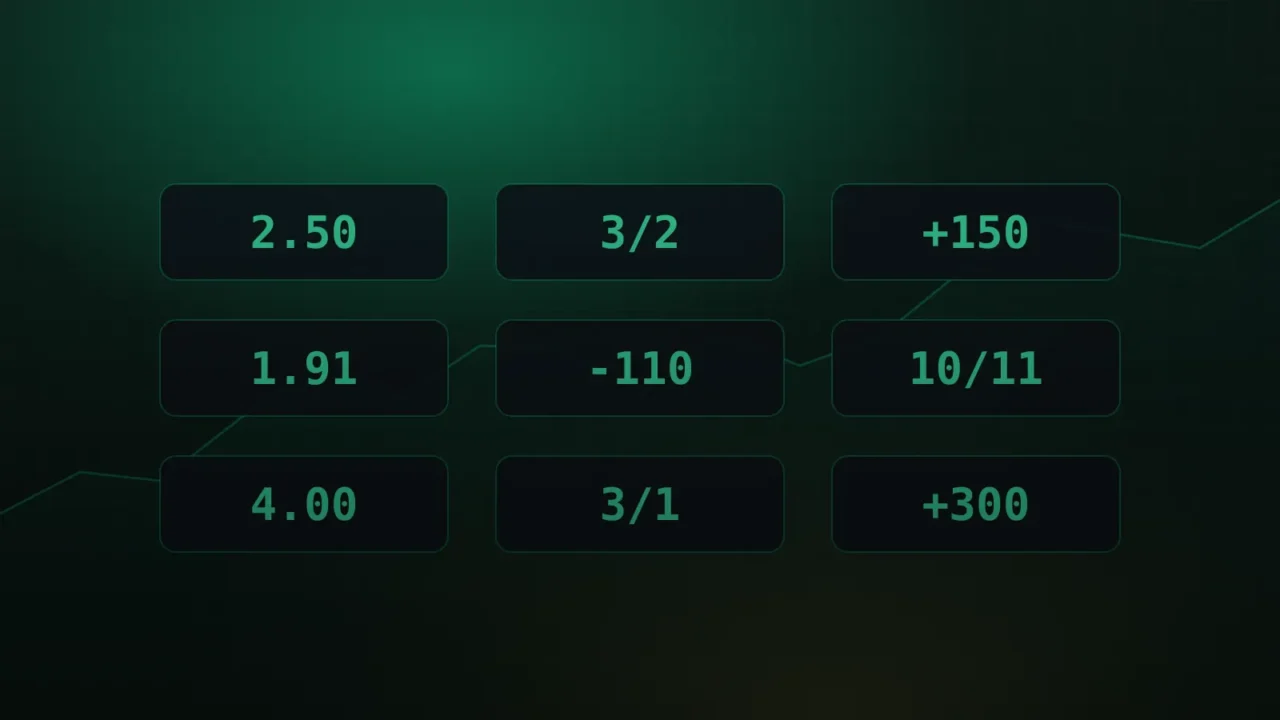
Table of contents
Quick answer
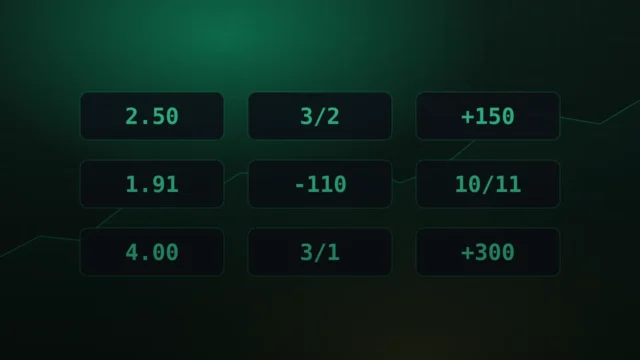
Betting odds show the payout for a winning bet and imply a probability. Decimal odds include your stake (2.50 returns 2.50 per 1 staked), fractional odds show profit relative to stake (3/2 wins 3 for every 2), and American odds show profit on 100 (+150) or the stake needed to win 100 (-200).
What odds actually tell you
Every price answers two questions. How much will I get back if I win? And how likely does the bookmaker think this is? The three common formats — decimal, fractional and American — express exactly the same information in different ways.
Decimal odds
Decimal odds show the total return for each unit staked, including the stake. A 10 bet at 2.50 returns 25: 15 profit plus the 10 stake.
- Definition Decimal odds
- Total return = stake × decimal odds. Profit = return − stake.
Fractional odds
Fractional odds, traditional in UK and Irish racing, show profit relative to stake. At 3/2 you win 3 for every 2 staked; at 10/1 you win 10 for every 1. To convert to decimal, divide and add one: 3/2 = 1.5 + 1 = 2.50.
American odds
American (moneyline) odds are built around 100:
- Positive numbers show profit on a 100 stake. +150 wins 150.
- Negative numbers show the stake needed to win 100. -200 means staking 200 to win 100.
| Fractional | Decimal | American | Implied probability |
|---|---|---|---|
| 1/2 | 1.50 | -200 | 66.7% |
| Evens | 2.00 | +100 | 50.0% |
| 3/2 | 2.50 | +150 | 40.0% |
| 3/1 | 4.00 | +300 | 25.0% |
From odds to probability
The implied probability of a price is 1 ÷ decimal odds. A price of 4.00 implies a 25% chance. Add up the implied probabilities of every outcome in a market and you will get more than 100% — the excess is the bookmaker’s margin, explained in our overround guide.
Convert any price instantly
Decimal, fractional, American and implied probability — all at once.
Common mistakes
- Comparing a fractional price with a decimal one without converting.
- Forgetting that decimal returns include the stake.
- Treating implied probability as the “true” chance — it includes the margin.
Frequently asked questions
Which odds format is best?
They all describe the same price. Decimal is easiest for calculating returns; use whichever your bookmaker displays and convert when comparing.
What does odds-on mean?
Odds shorter than evens (below 2.00 decimal) — the market thinks the outcome is more likely than not.
Do odds tell me what will happen?
No. They reflect the bookmaker's view plus a margin. Unlikely outcomes happen all the time.
Sources & references
- UK Gambling Commission — consumer guidance www.gamblingcommission.gov.uk
- BeGambleAware — safer gambling advice www.begambleaware.org
- National Council on Problem Gambling www.ncpgambling.org
We check every figure against the source listed. Spotted an error? Request a correction.
Related topics